
Lightweighting Technology Mass‑Produced by Moriroku

The automotive industry is undergoing major change, with stricter environmental regulations and the rapid shift toward electrification. As a result, achieving overall vehicle lightweighting has become a critical priority.
Lightweighting is a key area of focus for every automaker, as it directly enhances not only fuel and energy efficiency but also overall driving performance. Among the various approaches, the use of resin components is gaining particular attention as a technology that enables both weight reduction through component integration and superior design flexibility.
Background of the growing demand for lightweighting
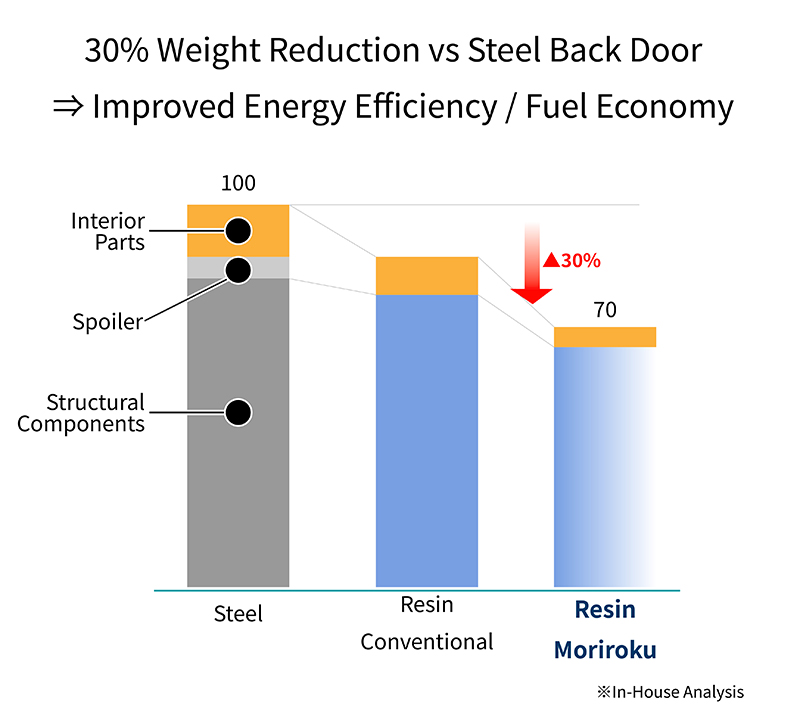
Lightweighting the vehicle body directly contributes to reducing CO₂ emissions in ICE (Internal Combustion Engine) vehicles by improving fuel efficiency, while also enhancing driving range for both ICE and EV (Electric Vehicles).
In EVs, where the battery accounts for a significant portion of total vehicle weight, reducing the weight of non‑battery components not only extends driving range and allows for smaller battery capacity, but also improves acceleration, deceleration, and handling performance—making lightweighting an essential technology for strengthening overall product competitiveness.
At Moriroku, we promote vehicle lightweighting by converting components traditionally made of metal—such as back doors—into resin.
Benefits of resin components
Design excellence and production efficiency
Resin components offer far greater design flexibility than metal, making it easy to realize complex curved surfaces and shapes optimized for aerodynamic performance. In addition, integrated design (component consolidation) enables a reduction in the number of parts, contributing to improved production efficiency and lower manufacturing costs.
-
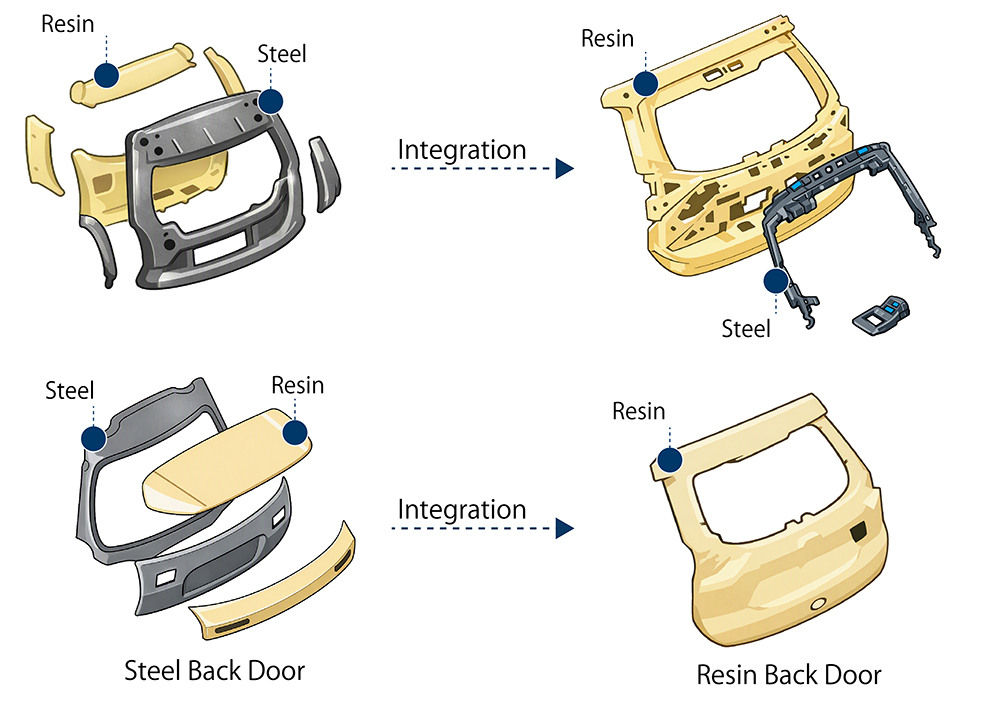
Component configurations for metal and resin Back Doors

Rigidity and durability comparable to metal
With advances in high‑performance engineering plastics, resin materials with excellent thermal and mechanical properties have emerged, expanding the range of applications where metal can be replaced. By optimizing every stage—from material selection to mold design and production processes—Moriroku achieves significant weight reduction while maintaining the same level of strength and durability as conventional metal components, which have long been the standard for exterior body panels.
Achieving both lightweight construction and high rigidity through exterior foam molding technology
Moriroku’s proprietary exterior foam‑molding technology uniformly disperses microscopic bubbles throughout the resin, significantly reducing material usage while maintaining high rigidity.
Optimization of the foam‑layer structure
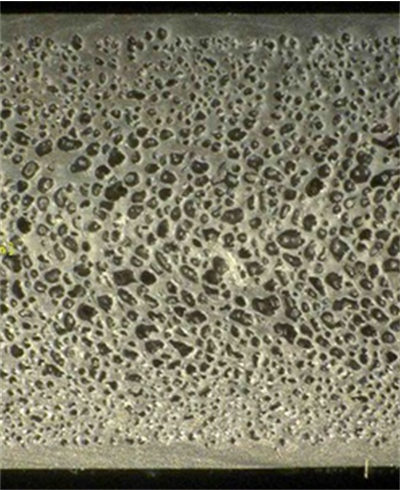
The molded part forms a composite structure consisting of a solid outer skin layer and an inner core layer with a porous microstructure. This configuration enables weight reduction while maintaining bending rigidity. In addition, the porous nature of the core layer helps suppress surface defects, further improving dimensional accuracy and exterior appearance quality.
Moriroku’s process technologies
Leveraging the proprietary technologies and expertise cultivated over many years, Moriroku optimizes every stage of development—from selecting the most suitable resin materials to designing products and molds based on performance and quality predictions using advanced simulation technologies, as well as refining production processes. Through this integrated approach, we are committed to delivering highly reliable products.

Case examples of resin Back Door adoption
Nissan ARIYA (Nissan Motor Co., Ltd.)
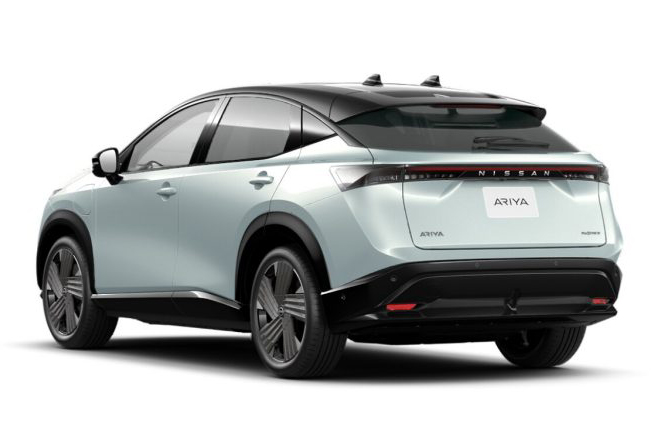
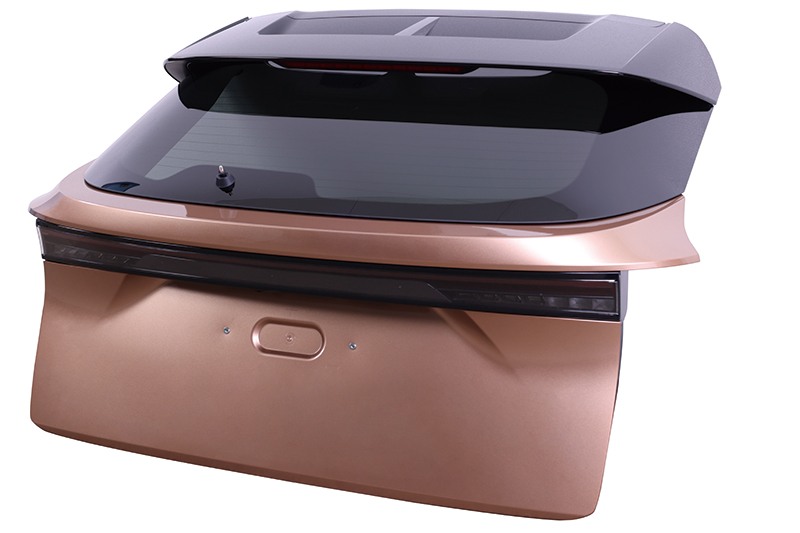
Moriroku’s resin back door has been adopted for the EV‑dedicated Nissan ARIYA.
In addition to achieving significant weight reduction, the integration of multiple parts into a single structure has reduced the total number of components.
Furthermore, the resin design enables a high degree of styling freedom that was difficult to realize with conventional steel back doors.
Case examples of exterior foam‑molding technology adoption
LEXUS RZ (Toyota Motor Corporation)
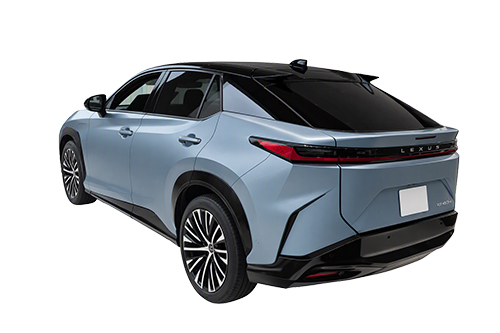
Moriroku’s exterior foam‑molding technology has been adopted for the exterior resin parts of the EV‑dedicated LEXUS RZ, including the side moldings and back‑door garnish.
This innovation achieved more than a 30% weight reduction compared with conventional components, contributing to extended driving range and improved energy efficiency.
Contribution to solving social challenges through Moriroku’s technologies
As environmental regulations tighten and vehicle electrification accelerates, weight reduction has become a critical technological theme in the automotive industry. Resin components not only contribute to lighter vehicles but also offer numerous advantages, including enhanced design flexibility, improved manufacturability, and cost reduction.
Through proprietary technologies such as resin back‑door development and exterior foam‑molding, Moriroku is helping advance vehicle lightweighting, improve fuel and energy efficiency, and support the realization of a carbon‑neutral society.
Moriroku will continue to pursue technological innovation and open new possibilities in automotive component development.